Energy Storage
under uncertainty

Optimization, machine learning and high-performance computing for renewable energy systems.

Optimization · machine learning · HPCHosted by TUM / administered by IAS

TUM-IAS Focus Group

Sustainable Energy Systems

The focus group on sustainable energy systems is working on problems at the intersection of optimization and machine learning to enable the transition of our energy systems to sustainable renewable energy supply while ensuring reliable service and energy affordability.

Renewable energy sources are a central pillar of future energy systems, because these resources can ensure energy affordability and security without compromising environmental sustainability. However, the massive penetration of renewable energy systems introduces significant challenges in the operation and planning of energy systems and electricity markets.

Our team focuses on the intersection of machine learning and optimization in order to mobilize system flexibility, especially in the form of storage resources. The specific methodological focus is on algorithmic advances for dynamic optimization under uncertainty, in order to mobilize system flexibility that can offset the unpredictable and variable supply of renewable energy.

Fellow
Anthony PapavasiliouNational Technical University of Athens
TUM host
Christoph GoebelTUM School of Engineering and Design
Research area
Advanced computation and modeling
Grant amount
€1 millionTotal funding over three years
Project details on AP-RG

Sustainable Energy Systems

Focus Group

Portrait of Anthony Papavasiliou

Anthony Papavasiliou

Fellow

NTUA

Short bio

Anthony is an associate professor in the department of Electrical and Computer Engineering at the National Technical University of Athens. Formerly he was an associate professor at the Center for Operations Research and Econometrics at the Université catholique de Louvain. Anthony completed his PhD and post-doctoral research at the department of Industrial Engineering and Operations Research at UC Berkeley, working with Professor Shmuel Oren. He completed his undergraduate studies at the National Technical University of Athens, Greece, in the department of Electrical and Computer Engineering. Anthony has served as an associate editor for Operations Research and the IEEE Transactions on Power Systems, and in the technical program committees of numerous international conferences. He has received the 2015 INFORMS best publication award in energy and the 2021 INFORMS best publication award in energy runner-up. In 2019, Anthony was awarded an ERC Starting Grant and in 2021 he received the Bodossaki Foundation Distinguished Young Scientist award in Applied Sciences. He have served as a consultant for transmission system operators, regulatory authorities, power exchanges, and utilities on a number of topics related to electricity markets and power system operations.

Christoph Goebel

TUM Host

TUM

Portrait of Alexandros Visas

Alexandros Visas

PhD Student

TUM

Short bio

Alexandros Visas holds an MEng in Electrical and Computer Engineering from the University of Patras and an MSc in Energy Production and Management from National Technical University of Athens. With professional experience in both the energy and defense sectors, he has worked on power system planning, renewable energy integration, and software integration for defense systems. He is currently pursuing a PhD at the National Technical University of Athens under the supervision of Anthony Papavasiliou. His research focuses on power systems optimization, renewable energy and battery storage integration, stochastic optimization, high performance computing, energy policy, and regulatory frameworks.

Sunny Chen

Research Associate

TUM

Research proposal

Proposal abstract

Storage as a Sustainability Enabler through Optimization, Machine Learning and High Performance Computing

Read the abstract

The integration of renewable resources in electric power systems is a highly challenging task due to the variability, unpredictability and limited control of renewable supply. Energy storage is a decisive solution to this challenge and creates the potential for the environmental benefits of renewables to cross over to the transportation and heating sectors through sector coupling.

However, the coordination of renewable supply and storage is a highly complex undertaking, due to the dynamic nature of the problem, the major role of uncertainty, the need to coordinate an enormous number of resources, and the non-linear physical laws governing the flow of power in electric power grids. Digitization presents an opportunity in overcoming this challenge by enabling metering, communication, and the deployment of optimization and learning technologies for intelligently coordinating the entire system.

In this proposal we aim at extending the state of the art in dynamic decision making under uncertainty with the support of machine learning, deploying our developed algorithms on high performance computing infrastructure and providing proofs of concept in various applications with broad potential.


A related experiment

Make the market visible.

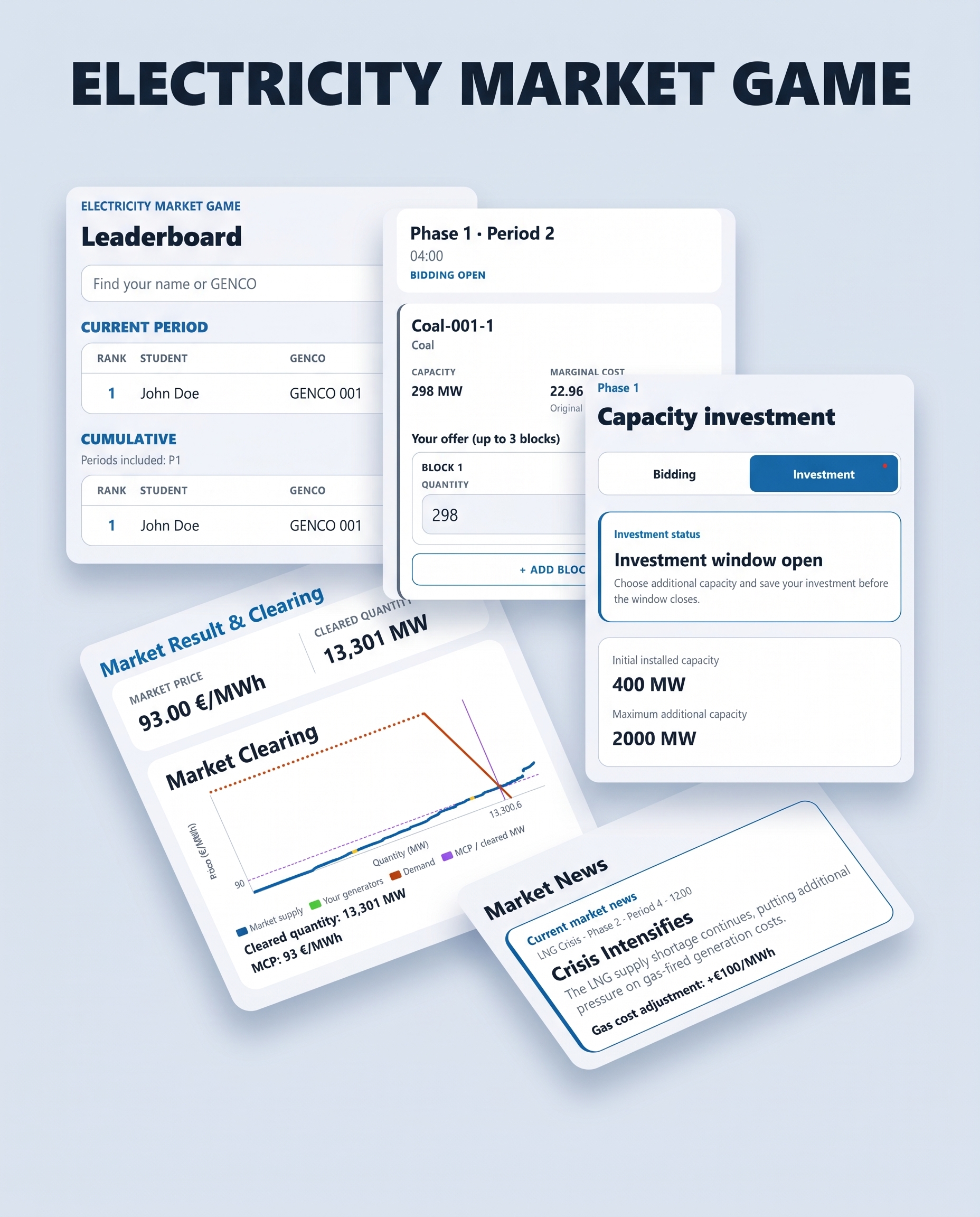
The Electricity Market Game turns price formation and investment decisions into a shared classroom experiment.

Illustrated student interface for joining and participating in the Electricity Market Game
Join with a Game Code from your instructor.
Your move

Bid. Clear. Learn.

Take the role of a generation company. Manage a portfolio, submit price bids and see how the market clears.

Bring price formation out of the lecture notes. Make a decision, discuss the market outcome and use the next round to test what you have learned.

Open the student app

The game scenarios

One market.
Three perspectives.

Start with normal conditions, then explore a supply shock and longer-term investment decisions.

01 / Price formation

A normal market

Submit generation offers and see how supply and demand determine which generators run. Connect your bidding decisions with the price the market clears at.

What sets the clearing price?

02 / Supply shock

An LNG crisis

Explore how pressure on gas supply changes the market for electricity. Reconsider your bids and compare the outcome with normal market conditions.

How does a gas shock reach electricity prices?

03 / Investment

Building capacity

Look beyond the next bidding round. Weigh investment in generation capacity against future market opportunities, and explore how those choices shape supply.

When is new capacity worth building?

Interactive illustration

What sets the price?

Change demand to see which generator is needed last, and how its offer sets the uniform clearing price.

Illustrative market / fixed demandLive model
Clearing price

€90 / MWh

Gas is the last generator needed to meet demand.

400 MW dispatched
100 MW600 MW
Illustrative offers and fixed demand. The full game uses participants’ bids and a price-responsive demand curve.

Research outputs

Publications (Test)

Journals

Conferences

Additional material

The support network

Ideas need support.

The funder, host university and administering institute each have a clear role in the fellowship.